


From the filing of a trademark application through examination and registration, the process can take many months or, in some cases, even years. During this period, circumstances may arise that make it important for a brand owner to secure registration as quickly as possible.
For example, a brand may be preparing for launch, and the owner may wish to have registered trademark rights in place at the time of launch. Counterfeit products may have entered the market, creating an urgent need to enforce trademark rights. Alternatively, a distribution or licensing agreement may be nearing execution, making it necessary to confirm trademark rights with business partners before proceeding with related commercial plans.
In such circumstances, securing trademark registration at the earliest possible stage can provide significant benefits for brand protection and management.
In response to the growing need for the prompt acquisition of trademark rights, Taiwan officially implemented the “Accelerated Examination Program for Trademark Registration Applications” on May 1, 2024. Applicants with a genuine need to obtain trademark rights promptly may request accelerated examination by the Taiwan Intellectual Property Office (“TIPO”) by stating the relevant facts and reasons, submitting supporting evidence, and paying an examination fee of NT$6,000 for each class designated in the application.
Just how fast is the “Accelerated Examination Program”? In practice, some applications have been approved within approximately one to two weeks after a request for accelerated examination is filed. For example, Application Nos. 113046383 and 113013723 were each approved within just 7 working days of the request for accelerated examination. Application No. 113058138 was processed even more quickly, receiving approval within only 5 days of the request, with the entire registration process completed in just 7 days.
According to TIPO statistics, since the implementation of this program, the shortest period from the filing of a request for accelerated examination to the conclusion of the case has been just 5 calendar days, while the shortest period from the filing of the trademark application to the conclusion of the case has been just 7 calendar days.[1]
By comparison, the average time to the first office action for a regular trademark application is 5.6 months.[2] For businesses with an urgent need to secure trademark registration, the Accelerated Examination Program can therefore significantly shorten the examination process and offer substantial benefits.
What Types of Cases Are Eligible for Accelerated Examination?
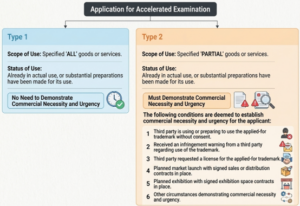
Pursuant to Article 19, Paragraph 8 of the Trademark Act, an applicant seeking accelerated examination must demonstrate an “urgent need to obtain trademark rights.” The applicable operating procedures clearly distinguish between the following two types of cases:
Type 1: All Designated Goods or Services Have Been Used or Are Substantially Prepared for Use
If all of the goods or services designated in the trademark application have already been put to actual use in Taiwan, or substantial preparations have been made for such use, the requirements for Type 1 are satisfied.
“Actual use” refers to use that satisfies the requirements of Article 5 of the Trademark Act, meaning that the trademark has been genuinely used by the right holder in accordance with generally accepted commercial practices.
“Substantial preparation for use” does not mean merely having an abstract concept for a market launch or engaging solely in internal discussions. Rather, the preparations must have reached a stage close to the actual offering of the goods or services in the market. The applicant should provide specific details regarding:
- The anticipated commencement date of trademark use
- The specific goods or services on which the trademark is intended to be used
- The marketing channels or venues where the trademark is expected to be used
Supporting materials may include samples of products or services bearing the applied-for trademark, advertising receipts, printing order confirmations, advertising contracts, and business plans, demonstrating that the trademark is intended for imminent commercial use.
Where the goods or services designated in the application include any goods or services that have not yet been put to actual use or for which substantial preparations for use have not yet been made, the applicant should, in accordance with the law, divide the application or reduce the designated goods or services to exclude such goods or services, so as to satisfy the requirements for accelerated examination.
Type 2: Some Goods or Services Are Already in Use or Being Prepared for Use, with Commercial Urgency
Where only some of the designated goods or services are already in use or are substantially prepared for use, the applicant must submit evidence of such use or substantial preparation and also demonstrate a genuine commercial need and urgency to secure the rights expeditiously.
Under the currently published operating procedures, the following circumstances may be considered to demonstrate a commercial necessity and urgency to obtain the relevant rights:
- The applied-for trademark has been used or substantially prepared for use by a third party without the applicant’s consent
- The applicant has received an infringement warning from a third party in connection with the use of the applied-for trademark
- A third party has requested a license for the applied-for trademark
- The applied-for trademark has been planned for market launch, and a sales, distribution, or other related agreement has been entered into with a business partner
- The applied-for trademark has been planned for exhibition, and a related agreement has been entered into with the exhibition organizer
- Other circumstances sufficient to establish a commercial necessity and urgency to obtain rights
As can be seen from the foregoing provisions, a claim of commercial necessity and an urgent need to secure the rights will not be accepted based merely on a vague assertion that there is an “urgent need to launch.” Rather, the applicant must provide objectively verifiable supporting documentation, such as infringement warning letters, correspondence concerning third-party licensing requests, sales or distribution agreements, or exhibition participation agreements.
Furthermore, in principle, the Accelerated Examination Program only applies to classes covering goods or services that are already in use or for which substantial preparations for use have been made. For any class in which there has been no use or preparation for use, the applicant should separately request a division of the application or a reduction of the designated goods or services. Otherwise, TIPO will exclude such classes from accelerated examination and process them under the regular examination procedure. Any accelerated examination fees already paid will not be refunded.
Recommendations and Guidance
The Accelerated Examination Program changes only the order in which applications are examined. It does not alter the substantive legal requirements for trademark registration. Not every application is suitable for accelerated examination, nor does acceptance into the program guarantee that a notice of approval will be issued promptly. Even where TIPO grants a request for accelerated examination, an application may still face objections if grounds for refusal exist under the Trademark Act. For example, the mark lacks distinctiveness or is likely to cause confusion with an earlier-filed or registered trademark. In such cases, the applicant may still receive an office action or a preliminary notice of refusal. Procedural delays may also arise where the designated goods or services are overly broad or unclear, the evidence of use is inconsistent with the mark as filed, or the evidence cannot be clearly linked to the designated goods or services. Any of these issues may result in an office action and delay the examination process. In short, while accelerated examination can significantly reduce the initial waiting period, inadequate pre-filing preparation may simply mean receiving an office action or a preliminary refusal sooner, thereby substantially undermining the benefits of accelerated examination.
Therefore, before applying for accelerated examination, applicants should conduct a comprehensive assessment of the likelihood of registration, the classes of goods and services to be designated, the relevant business strategy or market launch plan, the actual status of use, and the availability of sufficient supporting evidence. This will help identify potential registration issues at an early stage, ensure that the scope of the application is aligned with the applicant’s commercial needs and available evidence, and reduce the risk of delays caused by ambiguities in the application or insufficient documentation.
This article is written by Partner Gary Kuo, Senior Associate Sophia Lee, and Researcher Yen-Ju Wei.
If you would like to learn more about the laws and regulations or related matters discussed in this article, please feel free to contact our firm at the following email addresses: gkuo@winklerpartners.com and slee@winklerpartners.com.
2 October 2026
[1] Taiwan Intellectual Property Office, Ministry of Economic Affairs, Intellectual Property Rights Monthly, Issue No. 324, p. 43, published on December 2, 2025.
[2] Press Release, Taiwan Intellectual Property Office, Ministry of Economic Affairs, “TIPO Announces Overview of Patent and Trademark Applications Accepted in 2025,” published on February 26, 2026.